Newsletter Fall 2025
Table of Contents
- Member & Dictionary News
- In Memoriam: Christine Ammer, Ian Lancashire, and Robert O’Neill
- 2025 DSNA Project Grant Winners: Blaine T. Billings and Martina Guzzetti
- DSNA25 Report (Walter Hakala and Lisa Berglund)
- The Whole World in a Book: An Exhibition and Symposium (Michael Adams)
- Grant Opportunity from the American Council of Learned Societies (Lisa Berglund)
- Society News (Lindsay Rose Russell)
- Upcoming Conferences
- Publication Information
Member & Dictionary News
Shawn Anthony Robinson’s article on dictionaries has been published by the Mensa Foundation: https://www.mensafoundation.org/decoding-dyslexia-dictionary-symbols/
David Gold shares news of a recently published article.
Gold, David L. 2025. “Sample entries of Slavic interest in a discursive etymological dictionary of Yidish in preparation.” Зборник Матице српске за славистику / Matica Srpska: Journal of Slavic Studies [= MIRACULUM VITAE: For Michael Borisovich Meylakh on His Eightieth Birthday]. Vol. 107. Pp. 409-420. https://www.maticasrpska.org.rs/category/katalog-izdanja/naucni-casopisi/zbornik-matice-srpske-za-slavistiku/
This article, which continues the author’s earlier research into Slavic influence on Yidish (chiefly Gold 1985, 2009b, and 2009c), consists of ten entries chosen to illustrate the diverse kinds of knowledge needed to solve etymological problems (not in every case, however, has a full etymology been determined) and the diverse kinds of problems that arise. All the entry heads treated here are Eastern Yidish (none of the few known Western Yidish words of Slavic origin is examined). Students of English and of Israeli Hebrew etymology will find certain entries relevant to their work.
What have you been up to? The DSNA loves to share news of member projects, publications, programs, and more! Please send your news to dsna.membernews@gmail.com for inclusion; deadline for submissions for the Spring 2026 issue is Monday 23 March 2026. You can also see and share what’s happening on DSNA’s Member Forum, Facebook, and X/Twitter.
In Memoriam
Christine Ammer, member and author of many lexicographical volumes, including The American Heritage Dictionary of Idioms, The A to Z of Investing, and The Encyclopedia of Women’s Health, passed away January 31, 2025.
Christine Ammer Obituary (1931 – 2025) – Lexington, MA – Boston Globe
Ian Lancashire, member and creator of the searchable open-access corpus and database Lexicons of Early Modern English, passed away April 3, 2025.
https://www.ridleyfuneralhome.com/obituaries/Ian-Lancashire?obId=41946321
Robert O’Neill, former member, friend of Warren Cordell, and author of English-Language Dictionaries, 1604-1900, passed away August 11, 2025
https://www.legacy.com/us/obituaries/bostonglobe/name/robert-o-neill-obituary?id=59185148
2025 DSNA Project Grant Winners: Blaine T. Billings and Martina Guzzetti
The DSNA is pleased to announce the second round of Small Grant Award winners, Blaine T. Billings (University of Hawai‘i at Mānoa) and Dr. Martina Guzzetti (University of Insubria and University of Milan).
Billings’ project, “Documentation of the Nasal lexicon and production of a Nasal dictionary,” was described by the Awards Committee as an exceptionally well organized and collaborative effort. The DSNA is delighted to support this project, whose goals and outcomes are defined by members of the Nasal community of Indonesia, working together with academic researchers to produce an urgently needed dictionary.
The committee was equally enthusiastic about Dr. Guzzetti’s project, “Medicine in women’s lexicography (1700s–1800s),” which focuses on the neglected genre of reference works compiled by women in the eighteenth and nineteenth centuries. The DSNA award will help Dr. Guzzetti in her work of constructing a corpus which will contribute to a broader and more inclusive understanding of the concept of “wellbeing” over time, and to understanding how medical knowledge was disseminated in these works.
Congratulations to the awardees!
DSNA25 Report
25th Biennial Meeting of the Dictionary Society of North America, May 29 to May 31, 2025
Buffalo State University hosted the 25th biennial meeting with support from the Buffalo State University English Department and School of Arts and Sciences, and the University at Buffalo’s Baldy Center, Humanities Institute, Department of English, and Department of Linguistics. The three-day event took place May 29-31, 2025, and was co-organized by Professor Lisa Berglund (Department of English, Buffalo State University) and Walter Hakala (Associate Professor of English, University at Buffalo). 83 people registered for the event, with 60 in-person and 23 virtual attendees. The conference featured 36 presentations organized in 13 sessions representing a wide range of topics related to dictionary making, study, collection, and use.
Several panels examined new technologies for compiling and consulting dictionaries, with scholars covering topics that range from AI automation to online accessibility. Miloš Jakubíček led a workshop on the Sketch Engine corpus management system, while several other papers addressed the use of digital technologies in the preservation of historical and endangered languages. With the generous support of our sponsors, we assembled several panels dedicated to the lexicography of indigenous languages, folk traditions, and topics related to lexicography and the law. Bilingual lexicography was well represented, with papers addressing languages like Caribbean English, Chinese, French, Persian, Punjabi, Sanskrit, Slovenian, Yorùbá, as well as less commonly studied languages like Central Cushitic, Zapotec, Itunyoso Triqui, and Kanien’kéha (Mohawk). Our final session was a public plenary discussion at the Central Library in downtown Buffalo reflecting on the past 50 years of DSNA history and speculating about the next half-century: “Will Dictionaries Exist in 2075?” The conference concluded with a reception at Big Ditch brewery. The complete program may be viewed here: https://bit.ly/DSNA2025program
The session entitled “Evolving Roles of Lexicography in Law” was among the best attended at the conference. Independent scholar Neal Goldfarb addressed the common criticism of dictionaries as “acontextual” in legal interpretation, suggesting that while dictionary definitions are indeed decontextualized, understanding how to read and interpret the contextual cues within entries could mitigate “definition shopping” by judges and litigants. Lindsay Rose Russell (UIUC) traced the historical development of queer lexicography, illustrating how legal precarity spurred the creation of lexicons of gay language, from the “Purple Pamphlet” to contemporary works, and how this process has evolved to queer the act of dictionary making itself by incorporating elements of desire, humor, and chaos. Finally, Edward Finegan (USC) examined the intersection of lexicography and trademark law, highlighting instances where trademark owners attempt to influence dictionary definitions and arguing for a more collaborative approach between linguistic experts and legal practitioners to better serve the needs of the courts without compromising linguistic accuracy.
The session on “Documenting and Revitalizing Indigenous Languages: Dictionaries, Technology, and Community” featured two University at Buffalo faculty, Karin Michelson and Christian Di Canio, both from the Department of Linguistics. Esénia Bañuelos (Bryn Mawr) examined the documentary practices involved in co-creating online Talking Dictionaries for Valley Zapotec communities, exploring their pedagogical application in both monolingual Spanish and bilingual educational settings. Christian DiCanio (UB) detailed the challenges and processes of constructing a functional bilingual dictionary for Itunyoso Triqui, an endangered indigenous language of Mexico, highlighting the complexities of its grammatical structure, particularly its tonal system, and the extensive collaboration required with Triqui speakers. Karin Michelson (UB) discussed the diverse approaches to Kanien’kéha (Mohawk) dictionary creation, showcasing how different historical and community priorities led to varied organizational structures and entry choices for a language known for its complex morphology.
With support from Cambridge Dictionaries, we were able to offer free day passes to students and faculty at our two institutions as well as to teachers at local secondary schools, who could use their attendance as professional development hours required for New York State teachers to maintain their professional certification.
A highlight of the meeting was President Kory Stamper’s address “My Life in Lexicography,” which was presented at the banquet, along with a short concert by the Catchwords.
The conference was held in conjunction with an exhibit hosted by the Buffalo & Erie County Public Library titled “What does it all mean? Exploring the Dictionary.” https://www.buffalolib.org/whats-happening/what-does-it-all-mean-exploring-dictionary
This exhibit showcases rare, famous, and unusual dictionaries from the BECPL’s collection. It also features informational panels that explain dictionary entry construction, word inclusion, the history of English lexicography, and highlight dictionaries of indigenous languages, queer and feminist lexicography, African American lexicons, satirical dictionaries, and slang. Co-curated by Lisa Berglund, BECPL Rare Book Curator Heather Gring, Walter Hakala, and UB English undergraduate Hannah Stocklosa, the exhibit will be on display till the end of the year.
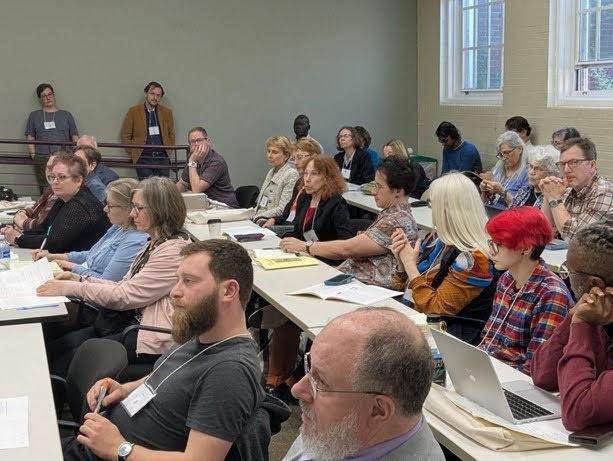
The panels featured lively discussion and were standing-room only.
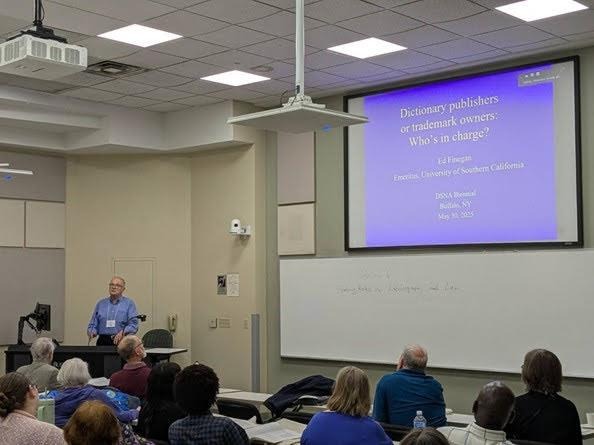
Edward Finegan (USC) presenting “Dictionary publishers or trademark owners: Who’s in charge?”
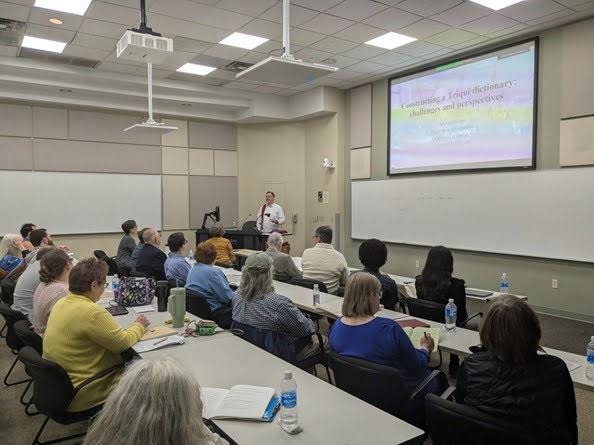
Christian DiCanio (UB Department of Linguistics) presenting “Constructing a Triqui dictionary; challenges and perspectives”
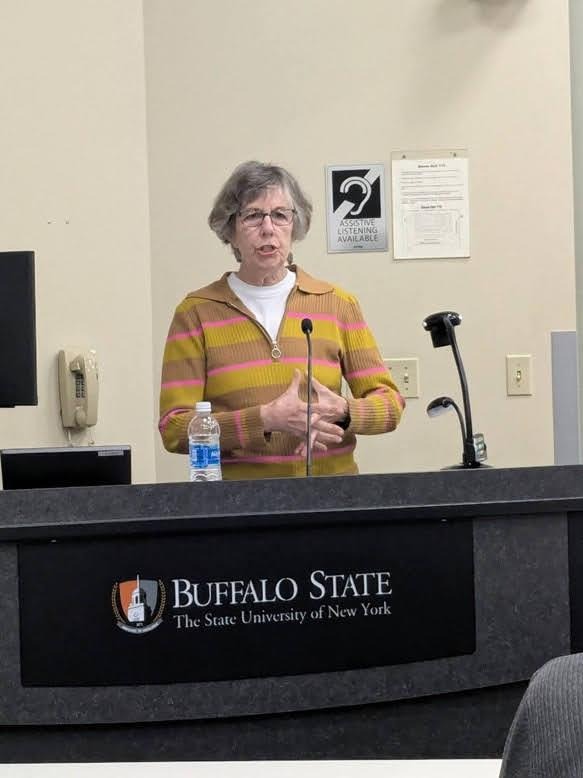
Karin Michaelson (UB Department of Linguistics) presenting “different perspectives, priorities, and choices for Kanienʼkéha (Mohawk) dictionaries”
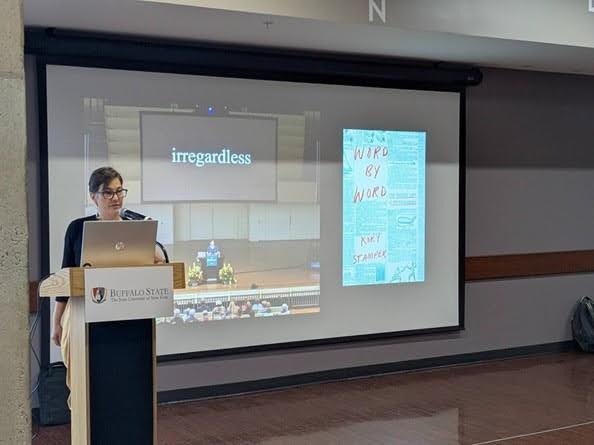
Outgoing DSNA President Kory Stamper delivered her presidential address at the conference banquet on Friday, May 30.
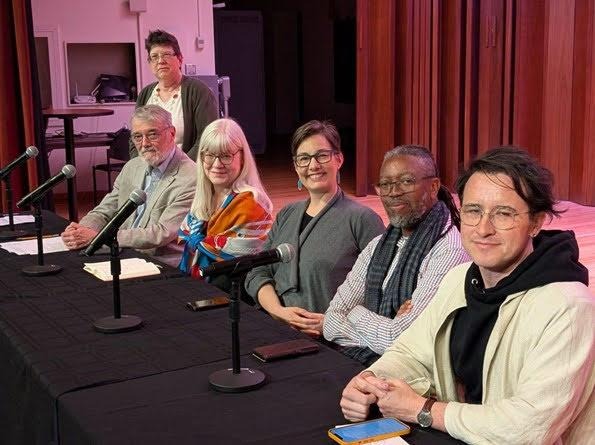
Plenary Discussion: “Will Dictionaries Exist in 2075? A Roundtable on the Past and Future of Lexicography,” featuring (left to right) Lisa Berglund (Buffalo State University); Michael Hancher (University of Minnesota); Wendalyn Nichols (Cambridge Dictionaries); Kory Stamper; Joseph Farquharson (The University of the West Indies, Mona), Orión Montoya.
-Walter Hakala and Lisa Berglund
The Whole World in a Book: An Exhibition and Symposium
It’s time to let you know how next February’s Kripke events are developing. Alas, very few people responded to the call for papers about collectors, collections, and collecting, so we won’t have a stream of sessions with standard-sized conference papers. We still have a robust schedule of speakers for a symposium, which we’ll hold starting late on Friday, February 20 and through Saturday, February 21.
At 4:00 on Friday afternoon, we’ll host a Q&A event with Stefan Fatsis, whose recently released book, Unabridged: The Thrill of (and Threat to) the Modern Dictionary not only covers the announced subject but also gives an account of the Kripke Collection — how Indiana University acquired it, what it’s like to open up boxes of materials from the collections (Stefan is one of the few who’ve had a chance to do so), and how the libraries are handling the collection now that it’s arrived in Bloomington. I hope readers of my blog Unpacking the Kripke Collection will already know Stefan’s best-selling book, Word Freak: Heartbreak, Triumph, Genius and Obsession in the World of Professional Scrabble Players (2002).
After that event, we’ll repair to the galleries, so that all attending can enjoy the exhibition, more on which below, and also enjoy the accompanying reception, as guests of the Lilly Library. During the reception, Stefan will be signing copies of Unabridged, copies of which will be available for purchase on-site.
Saturday’s program will warm the heart of any dictionary person. Jonathon Green (Green’s Dictionary of Slang, The Vulgar Tongue: Green’s History of Slang, Chasing the Sun: Dictionary Makers and the Dictionaries They Made), Jack Lynch (The Lexicographer’s Dilemma: The Evolution of “Proper” English from Shakespeare to South Park, You Could Look It Up: The Reference Shelf from Ancient Babylon to Wikipedia), and Lindsay Rose Russell (Women and Dictionary-Making: Gender, Genre, and English Language Lexicography) will all talk about the motives behind collecting dictionaries, from their distinct perspectives. So will Rob Rulon-Miller, of Rulon-Miller Books (St. Paul, Minnesota), who will talk about collectors and collecting from decades of experience as an antiquarian bookseller.
In addition, we have two intensive talks about specific (and perhaps unexpected) dictionary collections: Volker Harm, of the University of Göttingen, will talk about Richard Wagner’s dictionary collection (yes, that Richard Wagner); Elena C. Wicker, of the Clements Center for National Security and recipient of last year’s Honey & Wax Book Collecting Prize from Fine Books & Collections, about collecting military dictionaries.
The exhibition is shaping up as I write this, and I can tell you something about its contents. In the Lilly Library’s main gallery, there will be eight floor-cases dictionaries: two will be devoted to early lexicography; two to slang lexicography; two to nineteenth-century dictionaries; and one each to Hebrew and Yiddish dictionaries and school dictionaries. The main gallery also includes two large wall cases, one of which will be filled with Websteriana from Madeline’s collection, while the other will focus on dictionaries in everyday life and popular culture.
The Lilly Library holds many dictionary collections besides the Kripke Collection, including the Breon Mitchell Collection of Bilingual Dictionaries 1559–1998, the Barnhart Collection, the papers of Eric Partridge, and the Tom Dalzell Collection of Slang Lexicography, as well as untold dictionaries absorbed over decades into the Lilly’s general collection. Selected items from these collections will be displayed in the Slocum Room, adjacent to the main gallery How can a dictionary person miss an event like this? We hope many of you can attend. If you plan to do so, please register at the following link: https://events.iu.edu/libraries/event/kripke-symposium
We will hold the symposium in the newly renovated lecture room at the Lilly Library, but there is a limit to the number of guests we can accommodate in that room, so we need to know in advance who to expect. We have reserved a block of rooms in the Biddle Hotel in the Indiana Memorial Union which is very close to the Lilly Library, and you can make reservations here:
If these aren’t the accommodations you want or need, there are plenty of other places to stay in Bloomington, but you will need to make those arrangements on your own. Likewise, except for the reception on Friday night, meals will be attendees’ responsibility, but that, in Bloomington, can be a treat — we have gourmet American cuisine, excellent Italian and Mongolian food, ramen shops, ice cream, all within walking distance. The Indiana Memorial Union has coffee and breakfast food available.
If you have mobility issues, please let us know, and we’ll make sure you can attend the exhibition and symposium. In any event, if you have questions, don’t hesitate to write to Michael Adams at adamsmp@iu.edu.
-Michael Adams
Grant Opportunity from the American Council of Learned Societies
The following program may be of interest to lexicographers, particularly those working on indigenous or endangered languages projects. Funding for 2026-2027 has not yet been confirmed but you can get on an ACLS mailing list to receive news about the program. If renewed, the application period would be in fall 2026 and there is a robust workshop program supporting applicants through the process.
The ACLS Digital Justice Grant program is designed to promote and provide resources for projects at various stages of development that diversify the digital domain, advance justice and equity in digital scholarly practice, and/or contribute to public understanding of racial and social justice issues. This program supports digital projects across the humanities and interpretative social sciences that critically engage with the interests and histories of people of color and other historically marginalized communities through the ethical use of digital tools and methods. In this way, the program seeks to address the inequities in the distribution of access to tools and support for digital work among scholars across various fields, those working with under-utilized or understudied source materials, and those in institutions with less support for digital projects.
The program offers two kinds of grants: Digital Justice Seed Grants for projects at early stages of development; and Digital Justice Development Grants for projects that have advanced beyond the start-up or early phases of development. Please visit https://www.acls.org/programs/acls-digital-justice-grants/ for more information.
-Lisa Berglund
Society News
For me, the rumble-tumble-Niagara of DSNA25 — packed with compelling and varied presentations, a stunning and stirring presidential address, and radical visions of our lexicographical future — still feels like a fizzy rainbow refraction of delight and intellectual sustenance. I am grateful to be a part of this Society.
Walter Hakala and Lisa Berglund have contributed a recap of DSNA25 to this newsletter, but a quick account from a business standpoint: Unlike others in the American Council of Learned Societies, the DSNA does not generate revenue from conferences; instead, the Society keeps registration rates low and offsets conference expenses with sponsorships. This was true of DSNA25, which, through the industry and ingenuity of co-hosts Lisa Berglund and Walter Hakala, was generously sponsored by Buffalo State University and the University at Buffalo, among others. Kory Stamper, host of the successful 2022 virtual biennial, generously donated her expertise to a last-minute pivot to hybrid that allowed us to sustain the spirit of international thought and collaboration that is central to the DSNA. Thus, the 55 folks gathered in Buffalo were joined by 21 members from across the globe. If you missed the conference, read more about the event from BSU host here and more about “What Does It All Mean,” the exhibition at Central Library, here.
Buffalo also marked the first meeting of the newly elected Executive Board: Lisa Berglund serving as President (having moved from Vice President), Wendalyn Nichols as newly elected Vice President, Joseph Farquharson and Tinatin Margalitadze returning as Members-at-Large, Felicia Jean Steele and Rachel Victoria Stone joining as newly elected Members-at-Large, Kory Stamper sitting at immediate Past President, and myself continuing as Executive Director. Investment planning and Dictionaries‘ new subscribe-to-open model were primary topics of business in May 2025. At our upcoming meeting in January 2026, we’ll address DSNA26, the new role of Communications Officer, and other member support initiatives. Please join me in thanking outgoing Executive Board Members-at-Large Jeanette Allsopp and Orión Montoya for their service to the Society, 2021-2025, as well as the members of the Nominating Committee — Michael Adams, Grant Barrett, Donna Farina, and Orin Hargraves — who helped identify our newest Board members.
Also worthy of warm welcome is the expanded Dictionaries Editorial Team: Working with our downright dazzling editor, M. Lynne Murphy, Iara Mantenuto has agreed to serve as a new associate editor specializing in indigenous lexicographies, while Paul D. Fallon is working as reviews editor.
-Lindsay Rose Russell
Upcoming Conferences
Collateral Data: Repurposing Lexica as Ethnographic Sources; Bergen, Norway; 23 – 24 April 2026; https://www.uib.no/ub/spesialsamlingene/178383/call-papers-collateral-data-repurposing-lexica-ethnographic-sources
GLAC 32 & SHEL 14: Germanic Linguistics Annual Conference (GLAC 32) and the Studies in the History of the English Language (SHEL 14) Provo UT, USA; 30 April – May 2 2026; https://glac-shel2026.weebly.com/
ICHLL16; University of Caen Normandie, France; 24 – 26 June 2026; https://ichll-2026.sciencesconf.org/
Afrilex; University of Venda, Thohoyandou, South Africa; 1 – 3 July 2026; https://www.afrilex.co.za/
Euralex; Vienna, Austria; 29 September – 3 October 2026; https://euralex2026.at.
Publication Information
The DSNA Newsletter is usually published twice a year, in the spring and fall. It is currently edited by Rachel Fletcher and Lindsay Rose Russell. Member news items can be sent to dsna.membernews@gmail.com; please include Member News in the subject line.
Our Executive Director is Lindsay Rose Russell.
Send correspondence re membership, etc. to
dsnaadmin@gmail.com
Dictionary Society of North America
Department of English, University of Illinois
608 S Wright St, Rm 208
Urbana IL 61801
USA
This issue: Vol. 49 No. 2 (2025)
Cumulative issue #100